Antigone On Strike: Modern Takes on Justice & Sisterhood
Sophocles' Antigone has captivated audiences for millennia, a timeless testament to the clash between individual conscience and state law. Yet, in an era of rapid social change and complex global politics, how do modern theatre-makers interpret this ancient tragedy? Recent adaptations have boldly pushed the boundaries, transforming the classical narrative into searing commentaries on contemporary justice, sisterhood, and the very nature of protest. This article delves into two such compelling reimaginings, exploring how they strip back, rebuild, and recontextualize Antigone's defiant spirit for today's world, often leading to thought-provoking and sometimes uneven Antigone review scores, precisely because of their radical departures.
Stripping Back Tragedy: Lulu Raczka's 'Fleabag-ified' Antigone at New Diorama
Lulu Raczka's contemporary re-working of Sophocles’ tragedy at the New Diorama Theatre made waves by consciously foregoing almost all classical elements. Gone are Kreon, the sense of hubris, and the looming threat of divine punishment. This production, set almost entirely within a sandbox-like circular pit, focuses intensely on an extended dialogue between Antigone and her sister Ismene. What emerges is a secularized, demythologized, and, as some have dubbed it, "Fleabag-ified" Antigone – raw, intimate, and deeply human.
The initial impression for many, and a point of discussion in any uneven Antigone review of such a radical take, might be its departure from tradition. It could be seen as reducing the play to its opening scene, making Antigone seem more opaque rather than less. However, upon deeper reflection, this reduction is a deliberate and powerful choice. The ethical battle is internalized, waged between the sisters, transforming the external struggle against state power into a profound, personal predicament. This brings to the forefront the devastating impossibility of Antigone’s dual roles – not just as a defiant citizen, but as a loyal daughter and sister.
Raczka's play begins with an almost childlike innocence, with Antigone and Ismene dancing, mimicking exaggerated displays. Yet, this quickly gives way to the stark reality of physical transgression. Antigone moves from "immaterial fantasy" to "physical action," culminating in her act of breaking into her own tomb, lifting the trapdoor, and upending the very sandbox of their shared past. Her intent is not to rob, but to inter, to reclaim her brother's twice-defiled body for the family crypt. In doing so, she buries not only Polynices but symbolically, herself. Ismene, meanwhile, chooses the security of inaction, a choice that, while sparing her the immediate consequences, burdens her with a different kind of cost ��� the burden of bearing witness. To delve deeper into this particular adaptation's deconstruction of classical tragedy, consider reading Fleabag-ified Antigone: Deconstructing Tragedy at New Diorama.
The tension in this Antigone doesn't stem from certainty, but from Antigone's inherent uncertainty, her willingness to see her conviction through to its logical, tragic endpoint, even if it means forfeiting her life. This intimate staging powerfully underscores that her protest is a challenge to the living, affirming her own life even as she sacrifices it.
Antigone On The Barricades: Alexander Raptotasios's 'Antigone [on strike]' at Park Theatre
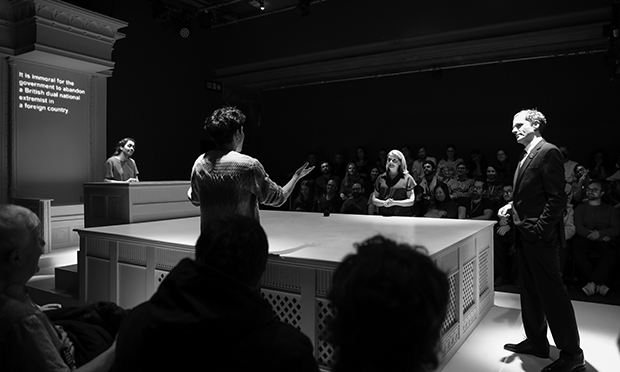
In stark contrast to the internalized struggle of Raczka's vision, Alexander Raptotasios's Antigone [on strike] at the Park Theatre boldly catapults the narrative into a contemporary socio-political landscape. Developed through discussions with East London schools, this reimagining addresses pressing issues of citizenship, public opinion, and state power in the modern age.
Here, Antiya (played by Hiba Medina) takes on the mantle of Antigone, staging a hunger strike in support of her sister Esmeh (Hanna Khogali). Esmeh is no mythical figure but an 'ISIS bride' who has lost her UK citizenship due to involvement with Iraqi jihadis. The modern Kreon is represented by Antiya's boyfriend, human rights activist Eammon (Ali Hadji-Heshmati), who also happens to be the son of an ambitious Home Secretary. This setup immediately raises the stakes, transforming the ancient dilemma into a scorching critique of current affairs.
Raptotasios's production grapples with questions of public opinion versus basic human rights – a debate as old as democracy itself, but terrifyingly relevant today. Should societal decisions be driven by the shifting tides of public sentiment, or must fundamental rights take precedence, even when individuals are perceived as threats? The play forces audiences to confront the complexities of justice when filtered through the lens of national security, media narratives, and individual accountability. This production showcases how the core themes of Sophocles' work, though set in a different era, continue to resonate deeply with our anxieties about civic duties, liberties, and the devastating consequences of state power when it intersects with personal loyalties.
The Enduring Power of Sisterhood in Flux
Both the New Diorama and Park Theatre productions, despite their vastly different approaches, underscore the profound and often devastating power of sisterhood as a catalyst for justice. In Raczka’s adaptation, the sisterly bond between Antigone and Ismene is the very crucible in which the ethical battle is forged. The intimate, almost suffocating dialogue illuminates the shared history and divergent paths, making Antigone's ultimate sacrifice not just an act of defiance, but a deeply personal, almost inescapable consequence of her familial duties. The tension and beauty are found in Antigone’s uncertainty, in the human struggle to reconcile love and moral imperative.
Conversely, in Antigone [on strike], the sisterhood between Antiya and Esmeh becomes the public battleground for a complex political issue. Antiya's hunger strike is a visible, visceral act of solidarity, a public performance of love and protest against a seemingly immutable state decision. Here, sisterhood transcends the personal sphere, becoming a symbol of individual agency and the fierce loyalty that challenges governmental authority. While some might find the specific contemporary political context overwhelming or, as an uneven Antigone review might suggest, overshadowing the universal themes, its power lies in forcing audiences to apply the ancient questions directly to today’s headlines.
These varied interpretations demonstrate that sisterhood in Antigone is not merely a subplot; it is the very engine of the tragedy. Whether the conflict is internalized or externalized, the bond between sisters highlights the ultimate impossibility of Antigone’s position – caught between fiercely held personal values and the rigid demands of external power structures.
Beyond the Stage: Lessons for Modern Activism and Ethics
These modern takes on Antigone offer more than just theatrical entertainment; they provide vital lessons for contemporary discussions on activism, justice, and personal ethics. They prompt us to consider:
- The Power of Individual Conscience: Both productions emphasize the profound impact of one individual's unwavering conviction, even against overwhelming odds. Antigone's defiance, whether private or public, reminds us that true revolution often begins with a single, resolute act of conscience.
- The Nuances of Justice: By secularizing the narrative or embedding it in current events, these plays force us to grapple with the ambiguities of human law and justice. Is justice always served by upholding the law, or are there higher moral imperatives?
- The Role of Empathy in Decision-Making: The focus on sisterhood highlights how personal relationships can challenge impersonal state policies. It begs the question: how much empathy should influence legal and political decisions, especially when national security is at stake?
- The Evolving Face of Protest: From physical transgression and self-burial to hunger strikes and public campaigns, Antigone's methods of protest evolve with the times, yet their underlying message of defiance remains constant. They serve as a powerful reminder of the diverse forms activism can take.
In a world grappling with ever more complex ethical dilemmas, the reimagined Antigone continues to ask uncomfortable but necessary questions. For a deeper comparative analysis of these bold theatrical visions, explore Antigone Reimagined: New Diorama vs. Park Theatre's Bold Visions.
These adaptations demonstrate that Antigone's enduring legacy isn't about rigid adherence to an ancient text, but about its capacity to ignite fresh dialogue on timeless themes. While an uneven Antigone review might sometimes reflect discomfort with their radical departures, such productions are crucial for keeping classic narratives alive, relevant, and challenging for new generations.